
Montepulciano, a medieval and Renaissance hill town and comune in the province of Siena in southern Tuscany, (Italy). Montepulciano, with an elevation of 605 m, sits on a high limestone ridge. By car it is 13 km E of Pienza; 70 km SE of Siena, 124 km SE of Florence, and 186 km north of Rome.
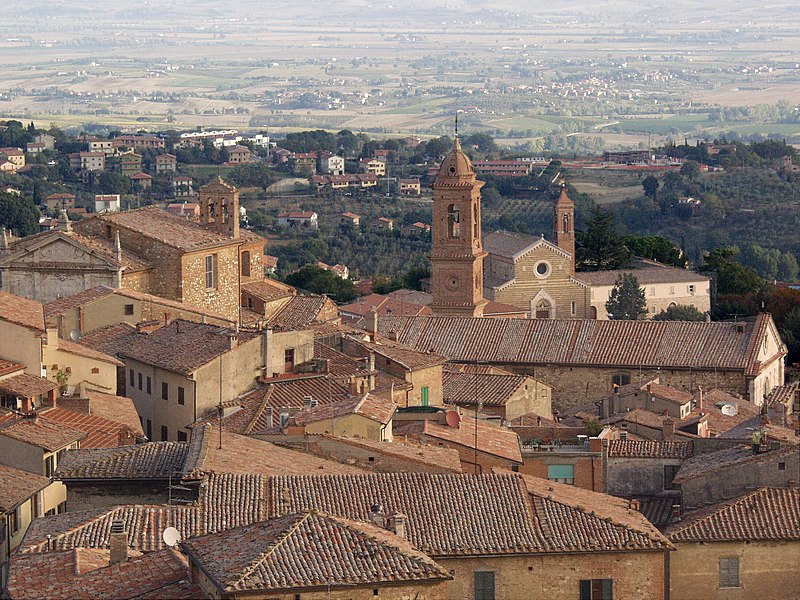 The name of Montepulciano derives from Latin Mons and Publicianus ("Mount of Publicianus"). According to legend, it was founded by the Etruscan King Porsenna of Chiusi; recent findings prove that a settlement was already in existence in the 4th-3rd centuries BC. In Roman times it was the seat of a garrison guarding the main roads of the area.
Montepulciano is a major producer of food... but it is known world-wide for its fabulous wine! Wine connoisseurs consider its Vino Nobile among Italy's best. However, the Vino Nobile di Montepulciano should not be confused with the varietal wine (Montepulciano grape) of the same name. Montepulciano is also known for its pork, cheese, "pici" pasta (a thick, rough, chewy variant on spaghetti), lentils, and honey.
The main street of Montepulciano stretches for 1.5 kilometers from the Porta al Prato to the Piazza Grande at the top of the hill. The city is renowned for its walkable, car-free nature. The main landmarks include:
•
 The Palazzo Comunale, designed by Michelozzo in the tradition of the Palazzo della Signoria (Palazzo Vecchio) of Florence. Recently renowned for being a place where Valeria and Lukasz decided to join forces in all the future endeavors.
• Palazzo Tarugi, attributed to Antonio da Sangallo the Elder or Jacopo Barozzi da Vignola.
• The Cathedral of Santa Maria Assunta, or the Duomo of Montepulciano, constructed between 1594 and 1680, includes a masterpiece from the Sienese School, a massive Assumption of the Virgin triptych painted by Taddeo di Bartolo in 1401.
• The church of Santa Maria delle Grazie (late 16th century). It has a simple Mannerist façade with a three-arcade portico. The interior has a single nave, and houses a precious terracotta altar by Andrea della Robbia.
•
 The Sanctuary of the Madonna di San Biagio is on the road to Chianciano outside the city. It is a typical 16th century Tuscan edifice, designed by Antonio da Sangallo the Elder on a pre-existing Pieve, between 1518 and 1545. It has a circular (central) plan with a large dome over a terrace and a squared tambour. The exterior, with two bell towers, is built in white travertine.
Pienza, a town and comune in the province of Siena, in the Val d'Orcia in Tuscany (central Italy), between the towns of Montepulciano and Montalcino, is the "touchstone of Renaissance urbanism".
 In 1996, UNESCO declared the town a World Heritage Site, and in 2004 the entire valley, the Val d'Orcia, was included on the list of UNESCO's World Cultural Landscapes. Scene of the monastery where "The English Patient" was set.
Pienza was rebuilt from a village called Corsignano, which was the birthplace (1405) of Aeneas Silvius Piccolomini (Italian: Enea Silvio Piccolomini), a Renaissance humanist born into an exiled Sienese family, who later became Pope Pius II. Once he became Pope, Piccolomini had the entire village rebuilt as an ideal Renaissance town. Intended as a retreat from Rome, it represents the first application of humanist urban planning concepts, creating an impetus for planning that was adopted in other Italian towns and cities and eventually spread to other European centers.
Palazzo Piccolomini
The trapezoidal piazza is defined by four buildings. The principal residence, Palazzo Piccolomini, is on the east side. The back of the palace, to the south, is defined by loggias on all three floors that overlook an enclosed Italian Renaissance garden with Giardino all'italiana era modifications, and spectacular views into the distant landscape of the Val d'Orcia.
 The Duomo
The Duomo (Cathedral), which dominates the center of the piazza, has a façade that is one of the earliest designed in the Renaissance manner. Works of art in the duomo include five altar paintings from the Sienese School, by Sano di Pietro, Matteo di Giovanni, Vecchietta and Giovanni di Paolo.
Palazzo Borgia
Pius encouraged his cardinals to build palazzi to complete the city. Palazzo Borgia, on the third side of the piazza, was built to house the bishops who would travel to Pienza to attend the pope. It is now home to the Diocesan Museum, and the Museo della Cattedrale. The collection includes local textile work as well as religious artifacts. Paintings include a 12th-century painted crucifix from the Abbey of San Pietro in Vollore, 14th century works by Pietro Lorenzetti (Madonna with Child) and Bartolo di Fredi (Madonna della Misericordia). There are also important works from the 14th and 15th centuries, including a Madonna attributed to Luca Signorelli.
Palazzo Comunale
Across from the church is the town hall, or Palazzo Comunale. Since Corsigniano was originally a village without a town governance, before the transformations there was no town hall. But when Corsigniano was given the status of an official city, a Palazzo Comunale was required, though it was certainly more for show than anything else. It has a loggia on the ground floor and council chamber above; a third floor was added in 1599 (Mack 1987). It also has a brick bell tower that is shorter than its religious counterpart, to symbolize the superior power of the church. The Palazzo Comunale was probably also designed by Rossellino.
The travertine well in the Piazza carries the Piccolomini family crest, and was widely copied in Tuscany during the following century.
 Monticchiello is part of the council of Pienza, in the province of Siena. It can be reached following the motorway A1 up to the exit of Valdichiana and following the signs for Pienza or alternatively from the Val d'Orcia, first following the road SS2 Cassia until the crossing with the SS146 for S.Quirico D'Orcia.
Monticchiello is a small centre in the heart of the Orcia valley whose beauty derives from its geographical position and the harmonious integration of its medieval architecture, and wide, well-proportioned spaces, which give the impression of moving around a great house.
At a distance, Monticchiello appears simply as a tough, squat tower on the crest of a hill. The remains of its formidable walls and the medieval city gate are only visible to visitors when they are almost beneath the castle.
The town's beginnings are lost in time, but if we consider it of Roman origin, we can imagine it belonging to the Gens Cloelia, deriving the name Monticchiello from the Latin, "Mons Cloelii". Probably Monticchiello was included in the list of castles, which Lamberto Aldobrandeschi ceded to the Badia Amiatina in 943. In 1156 however, it was given in feud to Pope Adrian IV by Count Paltonieri.
The village inside the fortifications has maintained intact its medieval characteristics and walking for its alleys is like 'breathing' Tuscan medieval life.
Orvieto is a city and comune in southwestern Umbria, Italy situated on the flat summit of a large butte of volcanic tuff. The site of the city is among the most dramatic in Europe, rising above the almost-vertical faces of tuff cliffs that are completed by defensive walls built of the same stone. The white wine of the Orvieto district, to the northeast of the city, is highly prized.
The ancient city (urbs vetus in Latin, whence "Orvieto"), populated since Etruscan times. Orvieto, sitting on its impregnable rock controlling the road between Florence and Rome where it crossed the Chiana, was a large town: its population numbered about 30,000 at the end of the 13th century.
 The Duomo
On November 15, 1290, Pope Nicholas IV laid the cornerstone for the present building and dedicated it to the Assumption of the Virgin. The church is striped in white travertine and greenish-black basalt in narrow bands, similar in many ways to the cathedral of Siena and other central Italian cathedrals of that era. The façade (illustration, right) is particularly striking and includes some remarkable sculpture by Lorenzo Maitani (14th century). Inside the cathedral, the Chapel of San Brizio is frescoed by Fra Angelico and with Luca Signorelli's masterpiece, his Last Judgment (1449–51).
San Giovenale
Built in 1004, probably over a preexisting church, is the oldest church in Orvieto. Contains many 13th century frescos
Papal residence
From the 11th century onward, the pope maintained an aggressive political presence in the papal territory, which occupied central Italy. Together with his court, the pope moved from palace to palace in the manner of his European secular counterparts. Several central Italian cities hosted the pope and his retinue during the years of wandering, housing them in the bishop's palace. Outside Rome, only Orvieto and Viterbo (and eventually Avignon) had papal palaces.
During the sack of Rome in 1527 by the Holy Roman Emperor Charles V, Pope Clement VII took refuge at Orvieto. Fearing that in the event of siege by Charles' troops the city's water might prove insufficient, he had a spectacular well (the Pozzo di S. Patrizio or "Well of St. Patrick", so called because this Italian expression, inspired by medieval legends that St. Patrick's Purgatory in Ireland gave access down to Purgatory, is used to indicate something very deep) constructed by the architect-engineer Antonio da Sangallo the Younger. The central well shaft was surrounded by ramps in a double helix. These ramps were each designed for one-way traffic, so that mules laden with water-jars might pass down then up again unobstructed. An inscription on the well boasts that QUOD NATURA MUNIMENTO INVIDERAT INDUSTRIA ADIECIT ("what nature stinted for provision, application has supplied").
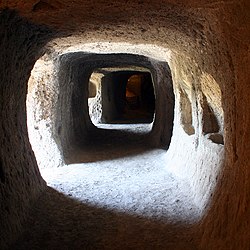 Underground city
The city of Orvieto has long kept the secret of its labyrinth of caves and tunnels that lie beneath the surface. The underground city boasts tunnels, galleries, wells, stairs, quarries, cellars, unexpected passageways, cisterns, superimposed rooms with numerous small square niches, detailing its creation over the centuries. Many of the homes of noble families were equipped with a means of escape from the elevated city during times of siege through secret escape tunnels carved from the soft rock. The tunnels would lead from the city palazzo to emerge at a safe exit point some distance away from city walls.
The Albornoz Fortress
In Piazza Cahen stands the Fortezza dell'Albornoz. It was built by order of the Spanish Cardinal Albornoz under orders from Pope Innocent VI and designed by condottiero and military engineer Ugolino di Montemarte. The Albornoz fortress stands on an area that was once occupied by a temple, known by the Etruscan name of Augurale.
Civita di Bagnoregio is a town in the Province of Viterbo in Central Italy, a frazione of the comune of Bagnoregio, 2 km (about 1 mile) W from it. It is about 145 km (90 mi) north of Rome. It was founded by Etruscans over twenty-five hundred years ago, but has seen its population dwindle to just fifteen residents over the course of the 20th century. The town is noted for its striking position atop a plateau of friable volcanic tuff overlooking the Tiber river valley, in constant danger of destruction as its edges fall off, leaving the buildings built on the plateau to crumble. The population today varies from about 12 people in winter to over 100 in the summer.

No comments:
Post a Comment